View Larger Map
 |
| From gay goy gourmet |
 |
| From gay goy gourmet |
I was aware that the subject covariates in my hierarchical 1-dimensional ideal point model induced greater dependence in the chain. The reason is obvious – the full conditional update of the subject parameters θ now incorporates two pieces of information from the previous iteration (both η and β). This means much slower mixing chains.
Parameter expansion (px-da) actually improves mixing over the standard data augmentation scheme. Liu and Wu (1999) prove that convergence is always faster, but it still seems like magic. The method is nearly identical to the Marginal Data Augmentation of Meng & van Dyk that Simon Jackman just added to ideal, except that I sample the expansion parameter α on the residual variance of the latent data from an inverse-Gamma distribution whose prior parameters you can change. MDA fixes the prior value of the expansion parameter at 1 (equivalent to IG(a,b) as a→0).
I'm not sure when ADM and KQ plan the next MCMCpack release, but the default in MCMCirtHier1d is px=TRUE. The figure below shows the improvement in autocorrelation: for two chains of 10k iterations thinned every 20 samples, after a burnin of 50k iterations, the autocorrelation (which drops of really, really slowly for some subjects) drops below that even of the naïve model without PX (not shown). The black line is with PX, the red line without.

 |
| From CSA 2k8 |
 |
| From CSA 2k8 |
 |
| From CSA 2k8 |
The dried leaves are quickly toasted over a bare flame — they send off a wonderful fragrance. If you don’t have any available, you can always prevail upon friends who do in other parts of the country to send them, as they will keep for several months dried.

While paging independently at different times through Kennedy’s Art, Alex, Nick, and Sebastian – at least in my memory – all noted with interest this recipe for Oaxacan Black Beef Stew.
Chichilo negro is a dramatic stew of meat an vegetables in a fragrant and complex black sauce, redolent of black chiles and toasted avocado leaves. It is one of the more important of the Seven Moles of Oaxaca and prepared in the villages of the Central Valley on festive occasions instead of the much heavier black Oaxacan mole. In the past it was always made with the black, bulbous, thin-skinned chilhuacle negro, which in recent years have become scarcer and very expensive, so chiles guajillos, charred black, are now often used.
This is Mexican food at its most exotic!
Chichilo is best served in shallow bowls—meat, vegetables, and plenty of sauce, with the final touch (as if that were necessary) of rajas con limon (page 359). Some black beans cooked de olla (page 179) and corn tortillas accompany this dish, whichis not, surprisingly, very picante.


I’ve never cooked one of these before, so I'm excited for it. I bought a big spiky one, you know, just to make life more interesting.
The chayote, sometimes called a vegetable pear, is indegenous to Mexico and has been cultivated by the Indians for centuries; they gave it a Nahuatl name, chayutli.
Several varieties are grown in Mexico: small cream-colored ones, dark and light green ones with porcupinelike prickles, and then the light green, smoother variety, puckered at both ends, that is found in most Latin American markets in the US.
Only when the last variety is very tender and freshly picked can the skin be eaten; otherwise it should be discarded. But the seed, or flat almond, inside is a delicacy.
The chayote is a perennial climbing plant that grows profusely over the tall trees in my orchard, but it can be trained over a wire frame or cama when grown commercially. The tuberous root is edible and delicious, but it should be left to experts to dig it up without disturbing the reproductive part of the root system on which the following year's growth depends. The root, called camote de chayote, chinchayote, or chintestle, depending on the region, is boiled and eaten by itself or made into fritters and has a pleasant, earthy taste rather like that of the Jerusalem artichoke (Kennedy, p.147).
 |
| From CSA 2k8 |
The Vesevo 2004 Aglianico Beneventano is a dark ruby purple and offers a complex nose of black cherry, spice and cassis aromas. On the palate it exhibits rich extracted black fruit flavors, with smoke, leather, and mushrooms notes. Aged in barrique for six months, the big and seductive beauty has all the assets of a superb wine with great balance and ripe gripping tannins. A terrific wine at a great price.
I had the 2005 on a recommandation at the Wine Merchant in St Louis (we walked around the store looking at the $10–15 range and he hit all my usual favorites like Luzón and Juan Gil from Spain and NQN from Argentina). Perhaps more leather than mushroom but definitely my kind of earthiness and still a lot of concentrated fruit. I had it with beet ravioli, which played nicely off the earthy qualities. The first sip is a big burst of Italian-ness. I’ll be finishing it tomorrow at lunch with my favorite tuscan beans and tomatoes.
 amtrak authorization; metaphor for candidates. According to Wikipedia, “During the Shinkansen's 44-year, nearly 7 billion passenger history, there have been no passenger fatalities due to derailments or collisions (including earthquakes and typhoons).”
 |
| From CSA 2k8 |
 |
| From CSA 2k8 |
 tom kha
Originally uploaded by gay.goy.gourmet
tom kha
Originally uploaded by gay.goy.gourmet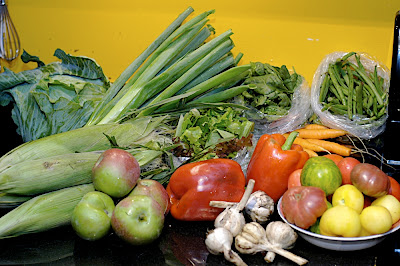 |
| From CSA 2k8 |
 |
| From CSA 2k8 |
If you live in a subdivision, condominium or co-op, it’s more than likely you’re part of a homeowners association (HOA). Used to be HOA focused on rather straightforward issues, like maintenance and repairs or landscaping of common areas. But they’ve expanded significantly since the mid-’60s and not necessarily for the good. … Some 54 percent [of homeowners surveyed] said they’d rather live with a “sloppy neighbor” than deal with an HOA.Count me among the majority. I once suggested in a social setting to Ryan, then just an aspirant to the esteemed title of condo association president that he now holds, that I and most people probably thought this way. I cited some of the absurd restrictions of Scott’s parents’ so-called community. Ryan seemed to view the association as a purely benign entity – countering that most if not all restrictions were “necessary” for “property values.” The problem is that people like him dominate the boards and people like me can’t tolerate the meetings they chair without wanting to blurt out (without Recognition from the Chair, of course), “you've got to be fucking kidding.”
- Copy this list into your blog or journal, including these instructions.
- Bold all the items you’ve eaten.
Cross out any items that you would never consider eating.- Optional extra: Post a comment at www.verygoodtaste.co.uk linking to your results.
In general, I am bad a ranking things, especially in the upper tail of their distributions. This is an exception. It is the essence of summer, made with strictly fresh ingredients at the peak of their seasons, and deeply, deeply satisfying. I submit that there could not possibly be any better midday meal than this tuscan-style bean and tomato stew served with red wine and good crusty bread.
There are a few rules to assert from the outset. First, this dish is to be served with red wine and crusty bread. No spoons, no soggy bread, no white wine, nor any other beverage. Second, I love bean and tomato stew even when it is made in the winter with dried or canned beans and canned tomatoes; however, that is simply bean and tomato stew. This is August stew and will allow no substitutions of these ingredients: fresh beans, fresh heirloom tomatoes, fresh garlic, and fresh herbs. By heirloom tomatoes I mean you either grew them yourself, or you talked to the farmer who did. Choose a variety like these Black Cherokees or even more acidic Green Zebras. Yellow tomatoes are generally low in acid, and I think a bad choice for this dish. Some of the marbley looking yellow-red ones are beautiful on the plate or in a salad, and should be saved for those uses. The herbs can be anything you have or grow or find. I've focused on basil today, but rosemary and thyme and sage and parsley are all good. I especially like sage in the winter version of the dish. Late August is also when the first juicy heads of mature garlic are coming to market. Common rubbery grocery-store stuff is not appropriate for this dish. Good crusty bread comes from an artisan bakery or your oven, ferments and rises for many hours, and contains no fat, only yeast, flour, water, and salt.
For two lunch servings, I used about half to three-quarters of a pound of beans, a pound of tomato (two large ones), four cloves of fresh garlic, chopped as large or as small as you like, and a quarter cup of olive oil. The quantities are flexible; if you like garlic, by all means add more.


Shell the beans, and by the time you’re done, 
the tomatoes will have broken down.


Eat. I like to start with the crustiest part of the bread. Any crumbs fall in, making it thicker; at the end, use the soft inside bread to mop up the bowl. If you run out of bread, get more. Do not use a spoon.

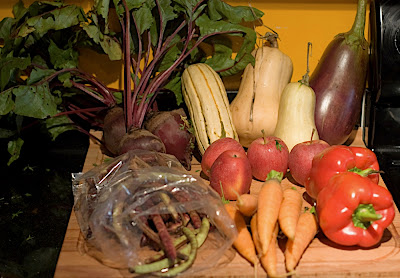
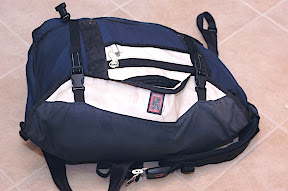
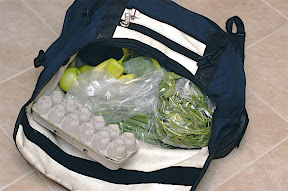
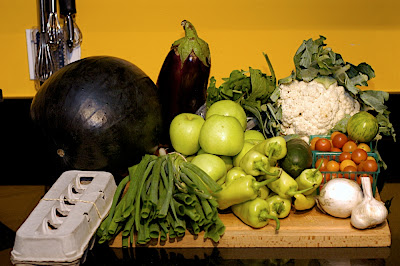
Nice of her to warn us! But the rest was insane! In addition to the watermelon – none sold, only for CSAers – there was a massive eggplant and a cauliflower and apples. See below.Subject: Watermelon alert Date: Tue, 12 Aug 2008 For those of you who ride bikes, walk, take the bus, etc., please note that if all goes as planned I will be delivering watermlons this week in addition to your regular boxes. They do make a heavier load so please plan accordingly. -- Thanks, Vicki


Thick, coconut milk-based curries from Mangalore, in southwestern India are called gassis. They are made tart with tamarind and are spiced with roasted assertive spices like chiles, fenugreek, and peppercorns. This classic curry incorporates pourltry, but fish and other meats are also fair game. Two forms of coconut, one as shreds, the other as milk, surprisingly do not overpower the curry, so any of you coconut-phobes out there, go ahead and indulge in this. Mound it over red or white rice.Among its ingredients: coriander, white poppy seeds, mustard seeds, fenugreek seeds, 4–6 thai dried chiles, tamarind paste.
A robust legume like this one needs assertive spices, and I usually find myself looking to the south (india, that is) for its dried red chiles, coconut, and coriander seeds. Serve this with the other southern (USA, that is) delicacy: warm, jalapeño-kissed corn bread. You’ll rethink your traditional chili–cornbread strategy for dinner.
Its latex code is now much readable, still uses dcolumn, still handles user-supplied standard errors, and it adds a host of features like omitting some rows of like controls, and model naming is flexible. Most importantly it matches variable names across models and leaves holes where they belong. Here's a snippet of sample output:
apsrTable(m1,m2,m3,omitcoef=4:17,lev=.1,align="c",model.counter=6,se="robust")
%Latex table generated by Mike Malecki's apsrTable()
%Uncomment the following line and the end one to change figure versions
%if you are using a full-featured family such as Minion Pro.
\figureversion{tabular}
\begin{tabular}{cD{.}{.}{-1}D{.}{.}{-1}D{.}{.}{-1}}\hline
 & \multicolumn{1}{c}{Model 6} & \multicolumn{1}{c}{Model 7} & \multicolumn{1}{c}{Model 8}\\
%                   & Model 6  & Model 7  & Model 8 \\
(Intercept)         & 71.95    & 35.95    & 38.83   \\
                    & (44.44)  & (38.63)  & (45.81) \\
maj.parl            & -2.03    & -4.81    & -0.86   \\
                    & (3.38)   & (3.52)   & (3.98)  \\
maj.pres            & -10.50   & -14.45 * &         \\
                    & (6.32)   & (5.42)   &         \\
lrCentered          & -1.26    &          & 3.71    \\
                    & (5.07)   &          & (5.52)  \\
pro.pres:lrCentered & -3.59    &          & -6.27   \\
                    & (6.61)   &          & (6.34)  \\
maj.parl:lrCentered & -4.46    &          & -8.52   \\
                    & (5.78)   &          & (6.73)  \\
pro.pres            &          & -8.81 *  & -3.36   \\
                    &          & (4.99)   & (5.46)  \\
N                   & 46       & 46       & 46      \\
$R^2$               & 0.82     &          & 0.81    \\
adj. $R^2$          & 0.70     &          & 0.67    \\
AIC                 &          & 310.38   &         \\
BIC                 &          & 434.72   &         \\
$\log L$           &          & -87.19   &         \\\hline
\multicolumn{ 4 }{l}{ Robust standard errors in parentheses} \\
\end{tabular}

\figureversion{proportional}
For example, I ride home almost every day the wrong way up a one way street, and nobody coming the other way gives a damn. Why should they? I honestly don’t give a fig about my carbon footprint (and anyway, since I’m not a breeder, I really should get carbon carte blanche).
The seismic shift by consumers to small cars from large vehicles has blindsided virtually every automaker. Only Honda Motor, where sales rose 1 percent in June, appears to have been prepared. The Japanese automaker’s Fit subcompact nearly doubled its sales during the month, and its Civic sedan set a June record.
By contrast, Toyota executives said they could not meet demand for its Prius hybrid-electric car or its small, fuel-efficient Corolla and Yaris models.
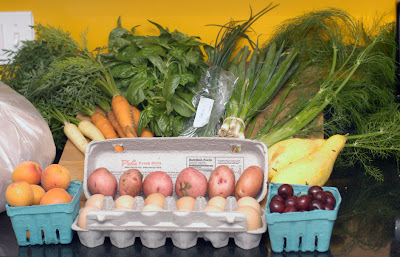
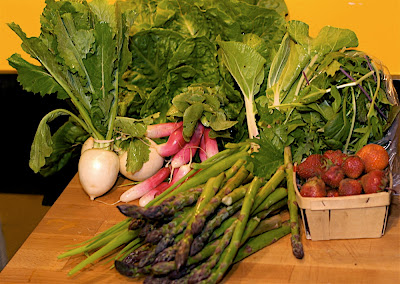
 We are going down to St Louis this weekend, so I can do some stuff before the methods meeting next week, and for Sebastian’s birthday and party. This affects food planning in two ways: we might bring one or two things down with us (in addition to the beautiful berries purchased for a sauce to go with his cake), and other stuff it would be nice to make a lot and freeze for next week. The box this week is extremely green and leafy, making that task a little trickier.

OK, custom type is cool. But the NYT’s presentation of the alternative – widely available commercial type – is incredibly irritating. There are two headlines to the article, one the real version and one in the web page title:
Down With Helvetica: Design Your Own Font
When Comic Sans Isn’t Enough
<rant>First, Helvetica is beautiful. Up with Helvetica, damnit! Yes, it is probably overused, but it is more than iconic – it’s the type foundation of innumerable icons, from the NYC Subway (and Chicago CTA, tracked tight and often lovingly kerned) to Panasonic, 3M, and even Microsoft.
Second, shouldn’t that be “Down with Times New Roman” (the default for the millions of Word users out there, and ugly whenever it’s larger than the 8- or 10-point size it was designed for) or “Down with Fucking Arial,” Microsoft’s incredibly skeezy (and ugly!) ploy to avoid licensing the real thing?
Third, on the web title: comic sans enough for what? Signaling to your readers that you’re a completely unsophisticated moron? Look no further than comic sans!
</rant>
This comprehensive overview in the making compiles the leading cases per Convention article - useful and extremely handy for both academics and practioners (and an authoritative addition to existing books which provide similar overviews). Thusfar Articles 6(1), 8, 34, 35 en Article 1 of the first Protocol have been made available online.
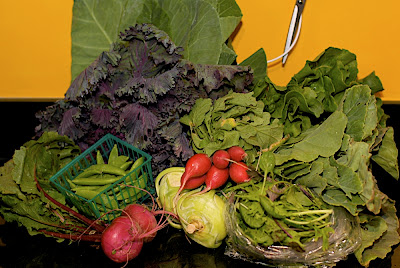
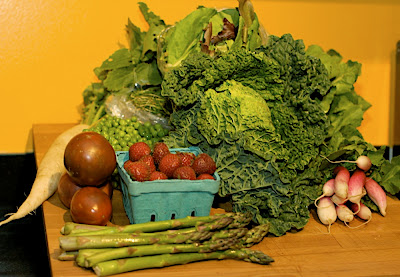

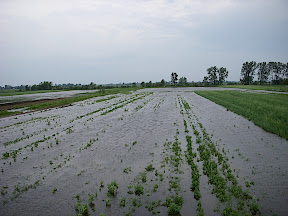
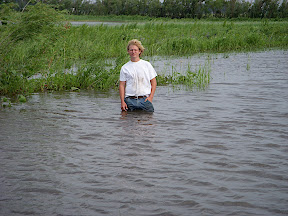
We were down in St Louis on Wednesday last week so we got our box on Saturday. The previous week witnessed some pretty awful flooding in Illinois and the farm was, in Vicki's words, in a state of emergency so we'll probably have two or so weeks of pretty lean boxes. She sent two pictures of the situation.
Nevertheless we got a box this week, and still had asparagus from last week. I also picked up some strawberries from Vicki and some shelled peas (one of my favorite things in the world) from Mick Klug.
Note: Many posts and recipes for a while at least will be tagged with a “660” indicating that they come from the new book 660 Curries by Raghavan Iyer. I was even more tickled to learn he was gay and has a kid. He writes in the preface, “My partner sowed the idea for a curry book, ‘a big one,’ he said, ‘nothing like any before.’”
I have already dubbed this summer the Summer of Indian Cookery for us, just as last year unofficially was the Summer of Mexican Food. That is not to say we will forgo the temptations of fresh masa nor luscious manteca, only that we are exploring another rich and exciting culinary tradition.
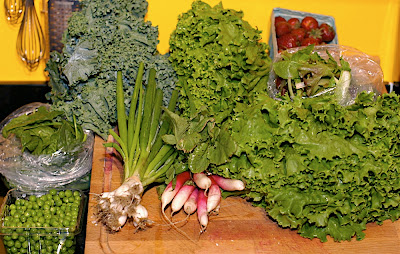
Yesterday I made pasta for the menu below, and had left over the ragged ends, the maltagliati or badly cut bits.
When I went to the Federal Plaza market this morning to get mushrooms to stuff with bacon and garlic (also see below), the mushroom people had morels of all things, for $60 a pound. I asked for $5 worth and promised that I wouldn't share them with anyone.
So, lunch today is pasta fresca maltagliata, with morels sautéed in butter, tossed with an egg and topped with a flurry of parmigiano. And a glass of wine, naturally.